
It seems we can’t find what you’re looking for. Perhaps searching can help.
Category Archives: PrimeKey Analysis: Property Investment Review
Given Singapore’s high property prices, buying a private property is one of the most significant financial decisions most people will ever make.
We are not talking about hundreds of thousands of dollars but rather close to a million dollars or much more. And yet, a surprising number of buyers still make their buying decisions based on how the property looks – whether it is a show flat at a new launch or resale unit, what you heard from the “grapevine”, or a vague sense that a particular location “feels right.”
That is a problem. In fact, a serious one, especially if you do not undertake a data-driven property investment review!
The High Cost of Getting Property Investment Wrong
Singapore consistently ranks among the most expensive residential property markets in the world. Buying requires significant upfront capital, and costs climb further once transaction fees are factored in, especially if it involves the Additional Buyer’s Stamp Duty (ABSD).
Hence, switching out of a bad property investment is not as simple as cutting your losses and moving on. A property that underperforms can tie up a significant portion of your net worth for years, eroding returns that could have been put to better use elsewhere.
And yet, the way many property buyers approach the decision would surprise you. They attend a show flat, wowed by the interior design, and convince themselves the location has “good vibes.” Or they read a few forums or social media posts, listen to someone who once sold a condo and take that as sufficient advice.
However, the property market is full of noise, opinion, and narrative. Not all of it is useful. Not all of it is accurate.
Gut feel and hearsay are not a strategy. At best, they might lead to a decent outcome through sheer luck. At worst, they can set you back financially for a decade or more.
Why Emotion is a Liability in Property Investment Decisions
There is nothing wrong with liking how a project looks. Aesthetics matter for liveability. But when appearances drive the investment decision, problems tend to follow.
Consider how easy it is to be influenced – a well-designed and polished showroom, a confident sales pitch from property agents, and carefully staged units that make every square foot feel generous. These are engineered to sell a feeling, not an investment rationale.
Developers spend considerable resources on marketing, and it works. People walk out of show flats emotionally convinced before they have asked a single hard question about the fundamentals.
What happens five or 10 years later when you try to sell? Interior finishes and fittings will not help you. What will matter is whether the location still commands buyer interest, whether the remaining lease is long enough to reassure the next buyer and how it affects bank financing, whether new supply in the vicinity has eroded your pricing power, and whether there is a realistic pool of buyers willing to pay what you seek.
These are fundamental considerations that even the most polished or carefully staged interiors cannot address.
A More Rigorous & Data-Driven Approach to Evaluating Projects
This is where a structured, data-driven framework becomes essential – cutting through hearsay, market noise, and emotional bias to focus on the factors that truly drive property performance.
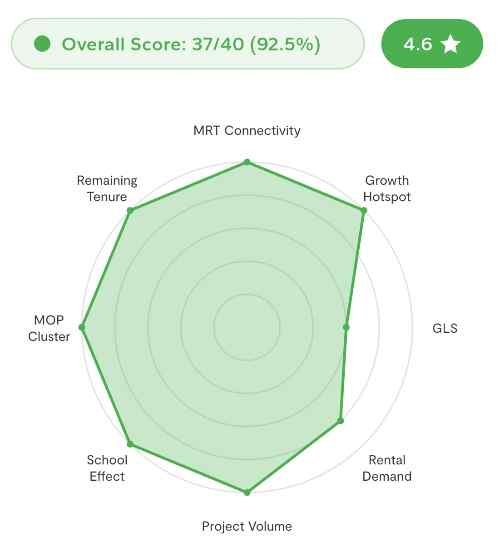
PrimeKey Analysis (PKA) evaluates each project across eight proven performance drivers:
- MRT proximity
- URA Master Plan alignment and growth potential
- Government Land Sales pipeline
- Development size
- Remaining lease tenure
- Rental yield
- Proximity to primary schools
- HDB upgrader demand in the surrounding
Together, they give a fuller picture of whether a project has broad buyer appeal and lasting value.
The PrimeKey Analysis framework produces a score, expressed as a percentage, which then translates into a colour-coded verdict.
- Green signals strong fundamentals and investment-grade potential.
- Yellow represents a sound profile with manageable trade-offs.
- Orange suggests elevated risks that deserve careful consideration.
- Red flags significant structural weaknesses where the probability of underperformance is high.
Crucially, the scores are not based on sentiment or prediction. They are grounded in observable market data and factors that have historically influenced buyer demand, price appreciation, and resale liquidity in Singapore’s private residential property market.
PrimeKey Analysis: Get Your Individual Property Investment Review
Our PrimeKey Analysis framework evaluates individual projects through the lens of investment potential rather than marketing gloss and sales narrative. Each review will provide the relevant information on how a project scores across the eight pillars, highlighting its risks and opportunities, and what investors should be aware of before making any commitments.
The goal is straightforward – to give you a clearer, more objective basis for evaluating whether a project genuinely merits your attention as an investment, not just as a home.
It also offers you side-by-side comparisons of competing projects that you are considering.
You should not have to rely on hearsay or gut feel when making such a significant financial decision. With the right framework and data, it is entirely possible to approach a property investment decision with clarity that significantly reduces the risk of getting it wrong.
That is how our PrimeKey Analysis property investment reviews here will help you. Please explore them.
However, if there are other projects you have in mind that are not covered here, please feel free to contact me to request a free copy of our PrimeKey Analysis Report (PKA).
Meanwhile, please explore our property resources, which covers the following areas:
- Property Investment Guides.
- Private Property Guides.
- Executive Condo Guides.
- HDB Guides
- Property Regulations.
- Property Finance & Costs.
- Property Marketing
- Property Hotspots.
You may also wish to learn more about the regional characteristics of Singapore’s housing landscape, which is broadly divided into the Core Central Region (CCR), Rest of Central Region (RCR), and Outside Central Region (OCR).