- Why Singapore's Housing Regions & Districts Matter
- Core Central Region (CCR)
- Rest of Central Region (RCR)
- Outside Central Region (OCR)
- Five Planning Regions vs Three Property Market Regions
- What Investors Should Look Beyond the District Number
- Final Thoughts on Singapore Housing Regions and Districts Guide
Whether you are a homebuyer or property investor, understanding Singapore’s residential market structure is an important first step when evaluating different locations. The market is broadly divided into three regions: the Core Central Region (CCR), Rest of Central Region (RCR), and Outside Central Region (OCR).
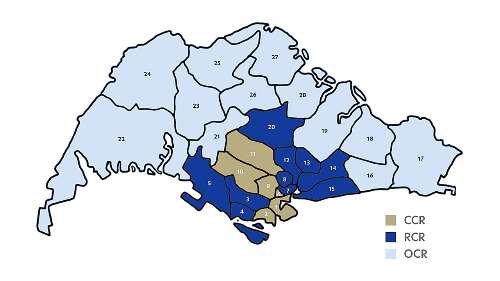
Singapore Housing Regions and Districts
These regions encompass 28 postal districts, each with its own characteristics, housing mix, amenities, connectivity and lifestyle appeal. Some districts may also span more than one broad region, depending on the specific location.
This Singapore housing regions and districts guide explains how the three regions and 28 districts are structured, offering homebuyers, investors, renters and expats with a clearer understanding of the key differences between Singapore’s residential locations.
However, the district number alone does not tell the whole story. Some districts span more than one region, while neighbourhoods within the same district can differ significantly in connectivity, housing environment, rental demand and future development.
Why Singapore’s Housing Regions & Districts Matter
The CCR, RCR and OCR classifications are used extensively in Singapore’s property market and by the Urban Redevelopment Authority (URA) for residential market analysis.
URA defines the:
- CCR as postal Districts 9, 10 and 11, Downtown Core and Sentosa.
- RCR as areas just outside the Central Region.
- OCR as areas outside most of the city fringe.
These regions broadly reflect different levels of centrality and market positioning. But they shouldn’t be read as fixed measures of property quality or investment performance. A CCR address doesn’t guarantee stronger returns than an OCR one, and vice versa – each still has to be judged on its own merits.
One complication worth highlighting is that postal districts don’t always sit neatly within a single region. District 4 is a good example, as it spans both Sentosa, among the most exclusive addresses in the CCR, and Harbour Front/Telok Blangah, which falls under the RCR.
Treating District 4 as a homogeneous market segment would obscure a fairly wide gap in pricing and positioning within the same postal code.
Similarly, Districts 5, 14, 15 and 20 also span areas classified under different regions.
This means buyers and investors should assess the property’s precise location rather than relying solely on its district number.
Core Central Region (CCR)
The Core Central Region represents Singapore’s most prestigious housing segment. It includes established luxury residential areas, the city centre and selected premium locations.
Major areas include Orchard, River Valley, Tanglin, Holland, Bukit Timah, Newton, Novena, Downtown Core and Sentosa.
Living Appeal
CCR generally appeals to people who prioritise centrality, convenience, established amenities and proximity to the city’s major commercial and lifestyle hubs.
Depending on the neighbourhood, residents can experience very different environments:
- High-rise urban living around the CBD and Marina Bay.
- Luxury shopping and dining around Orchard.
- Green and low-density surroundings in parts of Bukit Timah and Tanglin.
- Waterfront and resort-style living around Sentosa.
- Established housing precincts in the Newton–Novena corridor.
For expatriates and international renters, central locations can also provide convenient access to business districts, international schools, entertainment and lifestyle amenities.
CCR Property Profile
CCR contains a significant concentration of:
- Luxury condominiums.
- High-end apartments.
- Good Class Bungalow and landed housing areas.
- Freehold and leasehold developments.
- Mixed-use developments in the city centre.
Entry prices are generally higher but can differ substantially between individual neighbourhoods and projects.
Investment Considerations
For investors, CCR properties are often associated with premium locations and a tenant pool that includes professionals, executives and higher-income households.
However, higher capital values can affect rental yields. Investment analysis should therefore consider entry price, rental demand, competing supply, tenure, connectivity and potential exit demand, rather than assuming that a prime address automatically produces superior returns.
CCR Planning Areas & Districts Guide
| District Number | Planning Area | General Characteristics |
| 1 (Part) | Boat Quay, Raffles Place, Marina Downtown, Suntec City. | High-rise CBD waterfront living and nightlife hub. |
| 2 (Part) | Shenton Way, Tanjong Pagar. | CBD financial core with luxury residential towers and shophouses. |
| 4 (Part) | Sentosa. | Ultra-prime waterfront island resort living. |
| 6 (Part) | City Hall. | Prime civic, cultural, and historic central district. |
| 7 (Part) | Bugis. | Vibrant urban mix of arts, retail, and modern mixed-use towers |
| 9 | Orchard, Somerset, River Valley. | Premier shopping belt and flagship luxury residences. |
| 10 | Tanglin, Bukit Timah, Holland. | Exclusive landed estates, Good Class Bungalows, and lush greenery. |
| 11 | Newton, Novena, Dunearn, Watten. | Prime central homes anchored by major healthcare and medical hubs. |
Latest CCR New Launches
Below are some of the latest CCR new launches:
- Amberwood At Holland, a prime District 10 low-rise development at Holland Link.
- The Serra Residences, a rare freehold 133-unit boutique condominium at Novena.
- Dunearn House, an exclusive condominium in District 11 near Sixth Avenue MRT station.
- River Modern, a prime District 9 mixed development next to the Singapore River.
- Newport Residences, a mixed development in District 2 overlooking the Greater Southern Waterfront.
- W Residences, a branded mixed development in District 1 at Marina View.
Rest of Central Region (RCR)
The Rest of Central Region surrounds much of the CCR and comprises established city-fringe and central residential locations outside the CCR boundaries.
It includes areas such as Queenstown, Tiong Bahru, Alexandra, HarbourFront, Kallang, Toa Payoh, Geylang, Katong and Bishan.
Living Appeal & Experience
RCR offers a combination of central accessibility and established neighbourhood living.
Compared with the city centre, many RCR neighbourhoods have a more residential character, while remaining relatively close to major employment and lifestyle nodes.
The region includes distinctly different environments:
- Heritage and lifestyle areas such as Tiong Bahru and Chinatown.
- Coastal neighbourhoods such as Katong and Tanjong Rhu.
- Established heartlands such as Toa Payoh and Bishan.
- Employment and technology clusters around Buona Vista and one-north.
- Urban regeneration areas such as Marina South and the Greater Southern Waterfront.
This diversity makes RCR particularly relevant to buyers and renters who want central accessibility without necessarily living in the CBD or prime residential belt.
RCR Property Profile
The RCR contains a broad mix of:
- New and resale condominiums.
- Older private developments, including conservation houses.
- HDB estates.
- Mixed-use projects.
- Landed housing in selected neighbourhoods.
The housing environment can therefore vary considerably even within the same district.
Investment Considerations
RCR properties appeal to a diverse audience, from owner-occupiers, professionals and families to tenants who value accessibility to the city.
For investors, it is important to assess specific demand drivers for a specific location rather than relying on its regional classification. Factors such as MRT accessibility, proximity to employment hubs, schools and amenities, redevelopment plans, and competing housing supply often carry more weight than whether a project sits in the RCR, CCR or OCR.
RCR Planning Areas & Districts Guide
| District Number | Planning Area | General Characteristics |
| 1 (Part) | Marina South. | Emerging CBD extension focused on high-density waterfront living. |
| 2 (Part) | Chinatown. | City-fringe heritage precinct with vibrant commercial and residential activity. |
| 3 | Queenstown, Alexandra, Tiong Bahru. | Highly popular city-fringe estates blending heritage and modern living. |
| 4 (Part) | Harbourfront, Keppel, Telok Blangah. | Coastal fringe living surrounded by nature reserves and parks. |
| 5 (Part) | Buona Vista, Dover, Pasir Panjang. | Knowledge belt anchored by tech parks, universities, and low-rise condos. |
| 6 (Part) | Fort Canning. | Parkside living within the historic civic centre. |
| 7 (Part) | Rochor. | High-density urban fringe with mixed commercial and housing nodes. |
| 8 | Little India, Farrer Park. | Rich cultural enclave with city-fringe homes and medical facilities. |
| 12 | Balestier, Whampoa, Toa Payoh, Boon Keng, Bendemeer, Kampong Bugis. | Established central heartlands with famous food streets and rich amenities. |
| 13 (Part) | Potong Pasir, Bidadari, MacPherson, Upper Aljunied. | Rapidly modernising city-fringe residential cluster. |
| 14 (Part) | Geylang, Dakota, Paya Lebar Central, Eunos, Ubi, Aljunied. | Mixed-use estates combining commercial centers, light industry, and homes. |
| 15 (Part) | Tanjong Rhu, Amber, Meyer, Katong, Dunman, Joo Chiat, Marine Parade. | Premium coastal lifestyle area known for Peranakan culture and seafront condos. |
| 20 (Part) | Bishan, Thomson. | Highly sought-after central heartland with top schools and park access. |
Latest RCR New Launches
Below are some of the latest RCR new launches:
- Thomson Reserve, a mega development in District 20 next to Upper Thomson MRT station.
- Hudson Place Residences, a District 5 mixed development at Media Circle within One-North.
- Bloomsbury Residences, a District 5 mixed development at Media Circle within One-North.
- Arina East Residences, a District 15 freehold condominium at Tanjong Rhu.
- The Sen, a District 21 condominium at De Souza Avenue, next to Bukit Batok Nature Park.
Outside Central Region (OCR)
The Outside Central Region covers about two-thirds of Singapore’s residential areas and is mostly outside the city fringe.
Major locations include Tampines Regional Centre, Pasir Ris, Punggol, Sengkang, Hougang, Bedok, Jurong Lake District, Woodlands Regional Centre, Yishun and Tengah.
Living Appeal & Experience
OCR generally offers a more suburban, family-oriented and community-focused living environment.
Many towns are relatively self-contained, with:
- Town centres and shopping malls.
- Schools and childcare facilities.
- Parks and recreational spaces.
- MRT and bus networks.
- Healthcare facilities.
- Community amenities.
However, the OCR is far from homogeneous. For example, a coastal neighbourhood in the East can offer a very different lifestyle from a new township in Tengah, while Woodlands has a different economic and geographical role from Punggol.
This diversity is why individual neighbourhoods, not broad regional labels, should guide housing and investment decisions.
OCR Property Profile
OCR contains a substantial proportion of Singapore’s HDB housing stock, alongside a wide range of private condominiums and executive condominiums.
Compared with many central locations, properties in the OCR may provide:
- Larger units for a given budget
- Broader housing choices
- More family-oriented developments
- Access to newer townships
- Greater exposure to decentralised employment centres
Investment Considerations
OCR properties generally serve a broad owner-occupier and mass-market tenant base. Demand can be influenced strongly by:
- MRT connectivity
- Town-centre amenities
- Employment nodes
- Schools
- New infrastructure development
- Future residential supply
- Entry price
Major decentralised economic and employment centres such as Jurong Lake District, Punggol Digital District and Woodlands Regional Centre are examples of how Singapore’s growth is increasingly distributed beyond the traditional city centre.
OCR Planning Areas & Districts Guide
| District Number | Planning Area | General Characteristics |
| 5 (Part) | Clementi, West Coast. | West-side family hub near university and R&D corridors. |
| 14 (Part) | Kembangan, Kaki Bukit. | Quiet residential pockets adjacent to industrial parks. |
| 15 (Part) | Telok Kurau, Siglap, Frankel. | Low-density, peaceful coastal residential and landed enclave. |
| 16 | Bedok, Upper East Coast, Bayshore, Tanah Merah, Upper Changi. | Mature eastern residential belt with strong seaside connectivity. |
| 17 | Flora Drive, Loyang, Changi. | Quiet residential enclaves supporting aviation and airport business hubs. |
| 18 | Tampines, Pasir Ris. | Major eastern commercial hub packed with family amenities and parks. |
| 19 | Punggol, Sengkang, Hougang, Kovan, Serangoon, Lorong Ah Soo. | Massive residential corridor mixing heritage towns with waterfront smart estates. |
| 20 (Part) | Ang Mo Kio. | Mature, self-contained heartland with rich commercial amenities. |
| 21 | Upper Bukit Timah, Ulu Pandan, Clementi Park. | Serene residential zone bordered by nature reserves and educational institutions. |
| 22 | Jurong East, Jurong West, Boon Lay. | Major industrial and residential hub evolving into Singapore’s 2nd CBD. |
| 23 | Hillview, Bukit Panjang, Bukit Batok, Choa Chu Kang. | Green, family-focused suburban neighborhoods. |
| 24 | Tengah, Kranji, Lim Chu Kang, Sungei Gedong. | Next-generation smart “Forest Town” alongside countryside areas. |
| 25 | Woodlands, Admiralty. | Key Northern Regional Centre and main gateway to Malaysia. |
| 26 | Lentor, Springleaf, Mandai. | Peaceful, low-density green enclaves near nature and reservoirs. |
| 27 | Yishun, Sembawang. | Self-contained northern heartlands with strong community infrastructure. |
| 28 | Seletar, Seletar Hill, Sengkang West. | Quiet residential enclaves home to the Seletar Aerospace Park. |
Latest OCR New Launches
Below are some of the latest OCR new launches:
- Wynwood Grand, an executive condo in District 17 near Woodlands South MRT station.
- Solano Grand, an executive condo in District 23 near Jelapang LRT station.
- Lentor Gardens Residences, a District 26 condominium near Lentor MRT.
- Tengah Garden Residences, a District 26 mixed-development next to Hong Kah MRT.
- Vela Bay, a District 16 condominium next to Bayshore MRT overlooking East Coast Park.
- Narra Residences, a District 23 condominium at Dairy Farm Walk.
Five Planning Regions vs Three Property Market Regions
Another source of confusion is the difference between Singapore’s planning regions and property-market regions.
Singapore has five broad planning regions:
- Central Region.
- East Region.
- North Region.
- North-East Region.
- West Region.
These are broader urban-planning areas covering employment, housing, transport, recreation and future development.
The CCR, RCR and OCR, meanwhile, are residential property-market classifications used by URA. The Central Region contains 22 planning areas, while the CCR is a smaller market segment comprising Districts 9, 10, 11, Downtown Core and Sentosa.
Therefore, the two systems should not be treated as interchangeable.
How the Regions Differ for Homebuyers, Renters & Expats
The most useful way to compare the three regions is to consider the type of living environment each provides.
| Region | Typical Environment | Common Considerations |
| CCR | Central, premium, urban or exclusive | Convenience, prestige, amenities, higher entry cost |
| RCR | City-fringe, established and diverse | Connectivity, schools, amenities, balance between centrality and space |
| OCR | Suburban, community-oriented and varied | Space, affordability, family amenities, transport and future development |
For homebuyers, the decision should begin with lifestyle requirements, budget, commuting needs and preferred housing environment.
For renters and expatriates, commuting time, proximity to workplaces, schools, amenities and preferred neighbourhood character may be more important than the regional label.
For investors, the regional classification provides useful market context, but should be supplemented by property-level analysis.
What Investors Should Look Beyond the District Number
A district can provide a useful first filter, but it should not be treated as an investment conclusion.
When evaluating a property, consider:
- MRT and transport connectivity.
- Distance to employment centres.
- Schools and education nodes.
- Shopping, F&B and daily amenities.
- Existing and future housing supply.
- Land tenure.
- Entry price.
- Rental demand.
- Potential tenant profile.
- Future infrastructure and urban transformation.
- Competing developments.
- Exit demand.
URA’s Master Plan is particularly relevant because it sets out Singapore’s medium-term land-use plans and provides insight into future changes to housing, transport, employment, recreation and amenities.
If you are considering investing in a private residential property or executive condominiums, contact me to receive our PrimeKey Analysis report, a data-driven investment framework that evaluates eight key factors to surface a project’s strengths and weaknesses to help you make an informed purchase decision.
Final Thoughts on Singapore Housing Regions and Districts Guide
The classification of Singapore into the CCR, RCR, and OCR provides a key framework for urban planning, tracking demographic shifts, real estate valuation, statistical analysis, and policy formulation.
As outlined in this district’s guide, it establishes a structured price hierarchy where each of the Singapore housing regions has distinct land costs and supply levels, enabling the government to monitor market trends over time.
If you are thinking of investing in a property, refer to our resources and guides below:
- Property Investment Guides.
- Private Property Guides.
- Executive Condominium Guides.
- HDB Guides.
- Property Regulations.
- Property Finance & Costs.
- Property Marketing.