
- HDB Concessionary Loan vs Bank Loan: Which Should You Choose?
- Understanding SORA: Singapore’s Home Loan Benchmark
- 2026 Rate Environment: What It Actually Means for Your Decision
- Key Home Loan Terms and Penalties: What Actually Matters
- Refinancing vs Repricing: Knowing the Difference
- Borrowing Limits: MSR and TDSR
- Loan In-Principle Approval (IPA) Helps Determine Your Affordability
- The Role of Your Credit Score
- Costs Beyond the Loan: Budget for These Too
- Checklist: Questions to Answer Before You Choose a Home Loan
- Final Thoughts
- Review of New Property Launches
- Singapore Real Estate Resources
A home loan will almost certainly be the biggest financial commitment of your life. For most Singaporeans, we’re talking about a debt that can easily stretch 25 to 30 years and costs hundreds of thousands of dollars in interest before it’s cleared.
Get it wrong, and you’re not just losing money – you’re potentially locking yourself into a financial commitment that may limit your options for decades.
Although the stakes are high, the decision can be made more manageable once you carry out your due diligence.
This guide covers key aspects of loan application, including loan types, interest rate structures, the regulatory rules governing how much you can borrow, and what the interest rate environment actually means for your decision.
By the end, you should have sufficient clarity to walk into any bank with the right questions already in mind.
Foreigners who are interested in acquiring a property in Singapore can also apply for a housing loan, subject to meeting certain credit criteria, such as proof of income or net worth.
HDB Concessionary Loan vs Bank Loan: Which Should You Choose?
This is the first real decision HDB flat buyers face – should I apply for an HDB concessionary loan or a bank loan? For private property buyers, they can only apply for a bank loan.
The HDB Concessionary Loan
The HDB loan rate is pegged at 0.1% above the CPF Ordinary Account (OA) rate, which is currently fixed at 2.6% per annum. That number hasn’t moved much in over two decades, and that’s precisely the point – providing certainty.
For borrowers who want to know exactly what they’re paying every month – now and five years from now – this loan delivers that.
Key features:
- LTV (Loan-to-Value) Ratio: Up to 75% of the purchase price or valuation (whichever is lower), provided the flat lease covers the youngest buyer to age 95.
- Maximum tenure: 25 years.
- No Redemption Penalty: If you receive a windfall (striking a lottery or being given a big bonus, for example), you can pay down the loan without charge.
- Full Downpayment with CPF OA Allowed: No mandatory cash component, unlike bank loans.
- A Small Full Redemption Fee Applies: A registration fee of $38.30 plus conveyancing fees ranging from $22.00 to $88.00, depending on flat type.
Eligibility Conditions:
- Citizenship: At least one Singapore Citizen must be an applicant.
- Permanent Residents Eligibility: Need a Singapore Citizen co-applicant to qualify.
- Income Level: Gross monthly household income not exceeding $16,000 for families, $8,000 for singles, or $24,000 for extended families.
- Property Ownership: No ownership of private property locally or overseas in the 30 months before application.
- Outstanding Loan: No outstanding HDB loan on any other flat.
The HDB loan is particularly well-suited to first-time buyers, lower- to middle-income households, and anyone who genuinely values simplicity over scouring for the lowest possible rate. It also saves you the hassle of tracking interest rate movements every month or quarter, depending on your loan terms.
Bank Loans
Bank loans can be used to finance HDB flats, Executive Condominiums (ECs), and private properties. The trade-off for more options is more complexity. There are mainly two loan types:
- Fixed-Rate Loan: It locks in your rate for a set period, typically one to five years, before reverting to a floating rate. They’re useful when rates are rising or volatile, and you want to protect your cash flow.
- Floating-Rate Loan: It is pegged to SORA – the Singapore Overnight Rate Average, which replaced SIBOR and SOR since 2020. Banks package these as SORA plus a spread (for example, 1-month SORA + 0.30%). The 1-month and 3-month compounded SORA are the most commonly used. The 1-month variant reacts faster to market shifts, while the 3-month variant offers slightly more stability.
For bank loans, the LTV is capped at 75% for tenures up to 30 years. Unlike HDB loans, 5% of the purchase price must be paid in hard cash; the remaining 20% of the downpayment can come from CPF OA or cash. If the loan tenure exceeds 30 years or stretches past the borrower’s 65th birthday, the LTV drops to 55%, with 10% required in cash.
On the usage of CPF funds for property financing, please refer to CPF home financing rules.
[Note: Once you switch from an HDB loan to a bank loan, you cannot switch back to the former. It’s a one-way decision]
To gauge your affordability, use our Home Financing & Loan Calculator to estimate your monthly mortgage instalments.
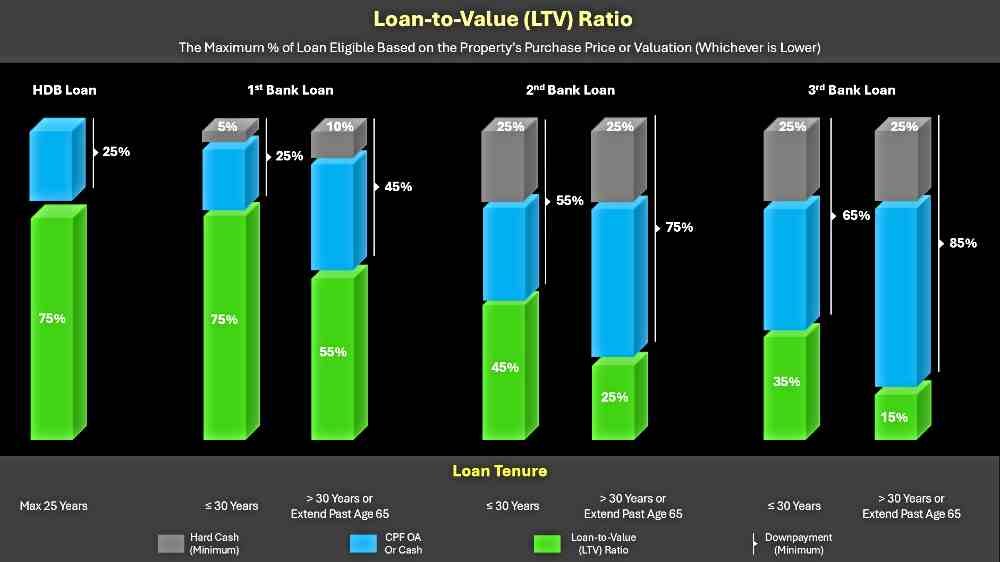
Loan-to-Value (LTV) Ratio
Understanding SORA: Singapore’s Home Loan Benchmark
SORA (Singapore Overnight Rate Average) is published daily by the Monetary Authority of Singapore (MAS). It reflects the volume-weighted average rate of actual overnight interbank SGD transactions between 8.00 am and 6.15 pm.
On the other hand, SIBOR (Singapore Interbank Offer Rate) was based on quoted rates from reference banks, while SOR (Singapore Dollar Swap Offer Rate) was partly derived from USD/SGD exchange rates, which introduce some foreign currency risk into home loan rate setting.
As SORA is based on actual market transactions, it offers a more robust and transparent benchmark.
In a falling rate environment – which was seen from 2025 into 2026 – SORA-pegged loans have looked increasingly attractive. As of June 2026, floating-rate packages were broadly available in the 1.25% to 1.50% per annum range. Compare that to HDB’s fixed 2.6%, and the gap is hard to ignore.
That said, borrowers on floating-rate loan packages need to be genuinely prepared for higher instalments if global rates shift. This isn’t a theoretical risk – anyone who took a floating rate package in 2021 suffered when interest rates spiked in mid-2022.
2026 Rate Environment: What It Actually Means for Your Decision
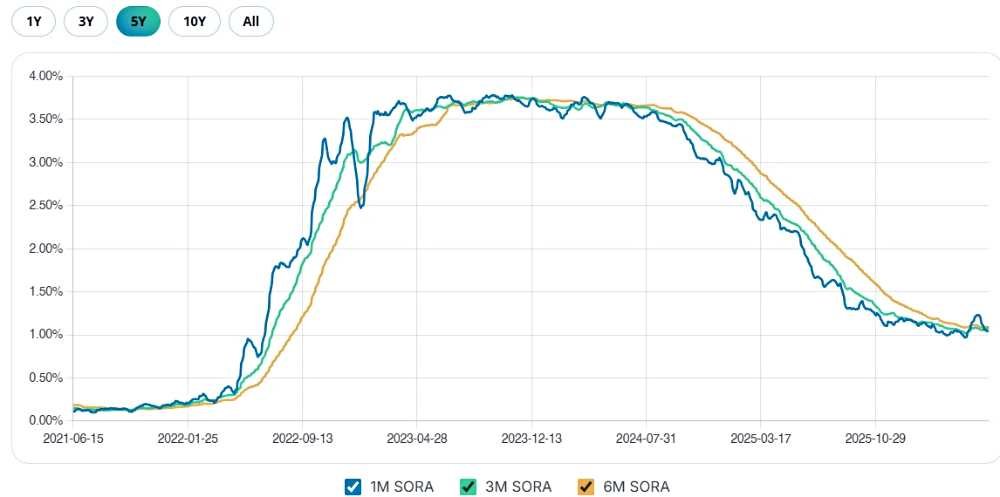
After rates peaked in 2023 and held high through much of 2024, SORA eased considerably through 2025. As of June 2026, fixed-rate packages are broadly available in the 1.40% to 1.50% range. Competitive floating packages are coming in as low as 1-month SORA + 0.20%.
This widening gap between bank loan rates and the HDB’s 2.6% has unsurprisingly prompted many existing HDB borrowers to consider switching to a bank loan. Whether this makes sense depends on factors such as your outstanding loan quantum, remaining tenure, income stability, and risk tolerance – not just the headline rate difference.
The decision isn’t just about finding the lowest rate. It’s about finding the loan structure that fits your financial position.
Borrowers with strong cash reserves and a long remaining tenure tend to benefit most from a floating bank rate. Those with tighter cash flows, or who simply don’t want the mental stress of tracking rate movements, are often better served by the HDB loan’s predictability – even at a higher headline rate.
Key Home Loan Terms and Penalties: What Actually Matters
Interest rate headlines attract all the attention, but the fine print often matters more. Here is what to scrutinise before signing any Letter of Offer:
- Lock-in Period: Most bank home loan packages come with a lock-in period of one to five years. During this window, redeeming the loan fully or partially (beyond any allowance) typically incurs a penalty of around 1.5% of the outstanding loan amount. If you sell your property or refinance during the lock-in, this can easily wipe out any interest savings. Always check whether a no-lock-in option is available, particularly for properties under construction (Building Under Construction or BUC loans).
- Partial and Full Redemption Penalties: Even outside the lock-in period, some packages impose conditions on partial repayments. For example, a minimum outstanding balance of $200,000 must remain after any partial redemption. Some banks allow up to 20% of the original loan to be repaid without penalty during the promotional period.
- Subsidy Clawbacks: Banks often absorb legal fees, fire insurance premiums, and valuation costs as acquisition incentives. If you refinance within a specified period (usually three years), you may be required to refund these subsidies – typically around $2,000. Factor this into your break-even calculation when considering refinancing.
- Interest Rate Reset Date: For borrowers on SORA-pegged floating packages, the interest rate resets periodically (every one or three months). Making a partial or full repayment – or attempting to refinance – before the reset date may trigger a breakage fee of approximately 0.5% of the outstanding loan. Always check your next reset date before acting.
- Late Payment Penalty: Missing an instalment incurs a penalty, either a fixed fee (around $80) or a percentage surcharge. Set up GIRO from the start to eliminate this risk.
- Cancellation Fee: If you apply for a home loan and subsequently withdraw, some banks charge a cancellation fee of approximately 1.5% of the cancelled amount. Be certain before committing.
- Step-Up Loan Structure: Most bank packages are structured on a “step-up” basis, where interest rates increase progressively over the loan term. Some lenders offer “step-down” packages that reward longevity with lower rates. Read the full rate schedule, not just the headline Year 1 figure.
Refinancing vs Repricing: Knowing the Difference
Once your lock-in ends, you’ve got two options: reprice or refinance:
- Repricing: It means switching to a new package within your existing bank. It’s faster and simpler – but banks know you’re an existing customer, not a new acquisition target, so the rates tend to be less competitive.
- Refinancing: It means moving to a different bank entirely. You potentially get access to new customer promotions, lower spreads, and fresh subsidies. But it will involve legal fees, valuation charges, and adhering to administrative timelines, such as giving advance notice to your current bank when switching.
Before refinancing, always calculate the break-even point: divide one-time switching costs by monthly savings to determine how many months it takes to recoup the cost. If it takes longer than your remaining lock-in runway, the move may not be worth it.
Borrowing Limits: MSR and TDSR
Two MAS-regulated ratios determine how much you can actually borrow. Understanding them before you start property hunting can save a lot of disappointment later.
- Mortgage Servicing Ratio (MSR): Applies to HDB flats and ECs. Your monthly mortgage repayment cannot exceed 30% of gross monthly income. For a household earning $8,000 a month, that’s a cap of $2,400 on the monthly instalment.
- Total Debt Servicing Ratio (TDSR): Applies to all property loans. All monthly debt obligations combined – home loan, car loan, credit card minimums, student loans, etc – cannot exceed 55% of gross monthly income. For the same $8,000 household, total monthly debt payments are capped at $4,400. Borrowers with variable income (freelancers, commission-based earners) face a 30% haircut on that income figure for TDSR computation.
HDB and EC buyers must satisfy both. Private property buyers need only clear TDSR. Running these numbers before you start viewing properties gives you a realistic ceiling on what you can afford, helping you to calibrate your realistic purchase price range.
Loan In-Principle Approval (IPA) Helps Determine Your Affordability
Before making any offer on a property, get your IPA sorted. This is a conditional commitment from the bank that specifies the maximum loan you qualify for, based on your income, credit standing, and existing liabilities. It’s not a guarantee – but it’s a good indication of the amount of loan you are eligible for at this stage.
For HDB flat buyers, the HDB Flat Eligibility (HFE) letter – which now incorporates the loan assessment – is mandatory before you can exercise an Option to Purchase. Applying via Singpass MyInfo speeds up the process considerably.
Most OTPs expire within two to three weeks. Knowing your loan ceiling in advance prevents the painful situation of securing an option only to find your financing falls short.
The Role of Your Credit Score
The Credit Bureau Singapore (CBS) runs scores from 1,000 to 2,000. A higher score improves your approval odds, may unlock better pricing, and increases the loan quantum you’re offered. It’s worth knowing where you stand before you apply.
Some of the main factors in determining your credit score include repayment history, credit utilisation ratio, how many credit applications you’ve made recently, and the age of your existing accounts.
The practical advice is simple – pay bills on time, don’t apply for multiple credit products in quick succession, and keep your credit card utilisation below 30% of your limit. None of it is complicated; it just requires proper financial prudence.
Costs Beyond the Loan: Budget for These Too
A home loan is only one component of the total cost of property ownership. Ensure your financial plan accounts for stamp duties, which could substantially add to your property acquisition cost:
- Buyer’s Stamp Duty (BSD): It is charged on all residential purchases on tiered rates: 1% on the first $180,000; 2% on the next $180,000; 3% on the next $640,000; 4% on the next $500,000; 5% to 6% on amounts above $1.5 million (rates effective from 15 February 2023).
| Buyer’s Stamp Duty (BSD) | ||
| Higher of Purchase Price or Market Value of the Property | Rates on or before 14 February 2023 | Rates on or after 15 February 2023 |
| First $180,000 | 1% | 1% |
| Next $180,000 | 2% | 2% |
| Next $640,000 | 3% | 3% |
| Next $500,000 | 4% | 4% |
| Next $1,500,000 | 5% | |
| Amount exceeding $3,000,000 | 6% | |
- Additional Buyer’s Stamp Duty (ABSD): Singapore Citizens buying a second or subsequent property pay 20%. PRs pay 5% from the first purchase. Foreigners buying any residential property pay 60% (as of April 2023). These are not small numbers.
| Additional Buyer’s Stamp Duty (ABSD) | Rates before 27 April 2023 | Rates from 27 April 2023 |
| SCs buying first residential property | 0% | 0% |
| SCs buying second residential property | 17% | 20% |
| SCs buying third and subsequent residential property | 25% | 30% |
| SPRs buying first residential property | 5% | 5% |
| SPRs buying second residential property | 25% | 30% |
| SPRs buying third and subsequent residential property | 30% | 35% |
| Foreigners buying any residential property | 30% | 60% |
| Entities buying any residential property | 35% | 65% |
| Housing Developers | 35% (remittable, subject to conditions) + 5% (non-remittable) | 35% (remittable, subject to conditions) + 5% (non-remittable) |
- Seller’s Stamp Duty (SSD): Sell within four years of a property purchase, SSD applies on a sliding scale, starting at 16% if sold within one year.
- Renovation costs, maintenance fees (for condos), conservancy charges (for HDB), property tax, and fire and home insurance.
| SSD Holding Period | Rates from 11 March 2017 to 3 July 2025 | Rates on and after 4 July 2025 |
| Up to 1 year | 12% | 16% |
| > 1 year and up to 2 years | 8% | 12% |
| > 2 years and up to 3 Years | 4% | 8% |
| > 3 years and up to 4 Years | 0% | 4% |
| > 4 years | 0% | 0% (no change) |
More details can be found in “How to Calculate Singapore Property Stamp Duties”.
Other Home Ownership Costs
Besides stamp duties, you will also need to take into account other costs of home ownership. These include renovation and repair costs, utility bills, maintenance fees (for private condos), conservancy charges (for HDB flats), and property tax.
In addition, take into account the property agent’s commission if you are engaging one. If you prefer to purchase an HDB resale flat without using a property agent, you can use the HDB Resale Flat Service to manage the process yourself.
It is prudent to set aside some savings for unexpected expenses or unexpected life events, such as job loss or medical treatments.
Checklist: Questions to Answer Before You Choose a Home Loan
Work through these before committing to any home loan package:
- Am I eligible for an HDB loan – and do I actually want the stability it offers?
- What is my maximum loan quantum under both MSR and TDSR?
- How much cash and CPF OA do I have available for the down payment and stamp duties?
- What monthly instalment can I genuinely manage – including a buffer if rates rise?
- Do I expect to make partial repayments during the tenure (bonuses, inheritance, CPF top-ups)?
- What is the lock-in period, and does it align with my likely holding or selling timeline?
- Are the bank’s upfront subsidies worth the clawback risk if I refinance my home loan?
- Have I actually calculated the break-even point for refinancing vs repricing?
- If it is a BUC (Building Under Construction) loan, and does it offer the flexibility to refinance after TOP?
- What is my CBS credit score, and have I addressed any issues before applying?
Final Thoughts
Choosing a home loan should not be a rate-shopping exercise. It’s a decision about how you want to manage risk, cash flow, and financial flexibility over the next two to three decades.
The rate matters, of course. But so does the structure, the penalties, the reset dates, and your own income stability.
Right now, with bank rates sitting meaningfully below the HDB’s 2.6%, the temptation to chase the cheapest headline number is understandable. But the best loan isn’t the cheapest one on paper. It’s the one that fits your cash flow, your life stage, and the plans you’re actually likely to follow through on.
Compare properly. Stress-test your assumptions. And talk to a licensed mortgage broker or financial adviser before you sign anything.
For further assistance, please feel free to Email or WhatsApp me.
Review of New Property Launches
For reviews of new property launches, please click on the links below. More project information can also be found here.
- Property Launches in Core Central Region (CCR)
- Property Launches in Rest of Central Region (RCR)
- Property Launches in Outside Central Region (OCR)
Singapore Real Estate Resources
- Property Investment Guides.
- Private Property Guides.
- Executive Condo Guides.
- HDB Guides.
- Singapore Property Regulations.
- Property Finance & Costs.
- Property Marketing.