- Political Stability Underpins Private Residential Demand
- Economic Fundamentals, Cooling Measures and Regulations
- Carefully Managed GLS Pipeline
- Land Scarcity, Tenure, and Freehold vs Leasehold
- New Launch vs Resale in the Private Condo Market
- Location, Amenities, and Transformation (CCR, RCR, OCR)
- Cost, Financing, Cash Flow and Exit Strategy
- Portfolio Strategy, Risk Management and Time Horizon
- Singapore Property Investment Strategies
- New Property Launches
- What Singapore Properties Can Foreigners Buy?
- Other Property Resources
Singapore property investment continues to be a preferred pathway for asset progression, particularly for investors seeking a balance of wealth preservation and long-term capital growth.
Supported by a transparent, tightly regulated environment and carefully managed supply, private residential properties across the Core Central Region (CCR), Rest of Central Region (RCR), and Outside Central Region (OCR) each present distinct risk-return profiles.
Investing effectively is not simply about chasing popular projects or freehold tenure. A structured framework that integrates policy considerations, supply dynamics, financing, and exit strategy is essential. Discover how our proprietary PrimeKey Analysis Framework can help you identify properties with strong investment potential.
Below are 8 key factors to consider when investing in Singapore’s residential properties.
Political Stability Underpins Private Residential Demand
Singapore’s political stability, strong institutional structures, and low corruption underpin sustained demand for private homes from both local buyers and overseas investors. As a regional financial hub and wealth-management centre, the city attracts high-net-worth individuals and family offices who often allocate capital into private residential property.
However, the imposition of a 60% ABSD in April 2023 on foreign individuals and corporate entities has substantially dampened demand. Nevertheless, citizens of the USA, Iceland, Liechtenstein, Norway, and Switzerland enjoy 0% ABSD on their first residential property due to their free trade agreements with Singapore.
To avoid the hefty ABSD, many families outside the above-mentioned nations have taken advantage of the Global Investor Programme (GIP) to secure PR status, which reduces their first-property ABSD to 5%. Alternatively, some seek to become Singapore citizens.
Why this Matters for Private Residential Investors
- A predictable legal and regulatory framework reduces expropriation risk and policy shocks that could undermine asset values.
- Continued inflows of capital into Singapore as a safe-haven support long-term demand, especially in prime and central segments.
Investment Tip:
Before committing to a private residential purchase, map your investment journey according to your objective:
- If your goal is wealth preservation, focus on projects that are backed by strong market fundamentals, reputable developers, and stable long-term demand - especially in the CCR or selected RCR areas - rather than choosing a property simply because it offers a higher short-term rental yield.
- If your focus is capital growth, selected city-fringe and prime fringe locations with sustained demand amid limited supply can combine to support stronger price appreciation over time.
Economic Fundamentals, Cooling Measures and Regulations
Singapore’s private home prices are closely linked to broader economic strength, employment, and borrowing costs. The government actively uses cooling measures such as Additional Buyer’s Stamp Duty (ABSD), Loan-to-Value (LTV) limits, and Total Debt Servicing Ratio (TDSR) to curb speculation and maintain market stability.
Key Implications for Private Residential Investors
- The market is designed to favour stability over extreme booms; price growth tends to be more measured but more sustainable
- Higher ABSD and stricter TDSR discourage overleveraged buying and reduce the risk of systemic distress, but they also compress short-term upside.
Investment Tip:
When planning to invest in a private residential property, evaluate the following:
- Policy-tightening scenario: Assume higher ABSD or stricter financing rules and check if your returns still make sense under these financial burdens.
- Rate-stress scenario: Model mortgage rates 1–2% above current levels and test if your cash flow remains manageable.
If your numbers only work under “best-case” assumptions, the deal is likely too fragile to withstand market- or Singapore’s policy-driven changes.
Carefully Managed GLS Pipeline
One of Singapore’s features to maintain price stability is disciplined supply management through the Government Land Sales (GLS) programme and monitoring of unsold inventory. New private residential launches are adjusted in line with demand conditions to avoid chronic oversupply or undersupply.
Why this Matters for Private Condos
- Controlled supply supports price resilience, particularly for well-located projects with limited direct competition.
- The number of unsold units in a sub-market provides a useful gauge of future downward pressure on prices and rents.
Investment Tip:
Before buying a new launch or resale condo, perform a basic supply check:
- Check how many similar projects (by price band and location) are in the pipeline or recently launched (contact me for an in-depth market evaluation using our proptech),
- If the area already has a large pipeline of comparable units, you may need to demand a better entry price or be more conservative on rental assumptions.
- Conversely, if unsold stock is low and GLS supply is tight, you can assign more weight to scarcity when evaluating potential price appreciations.
Land Scarcity, Tenure, and Freehold vs Leasehold
Singapore’s limited land area and managed reclamation mean that land scarcity is structural rather than cyclical. New GLS sites for private residential development are typically sold on 99-year leasehold terms, making freehold sites increasingly rare.
Tenure and Private Residential Performance
- Freehold condos often command a price premium, but that premium can erode yield if rents do not keep pace.
- Many 99-year leasehold projects have historically delivered strong price growth when well-located and purchased at sensible entry points.
Investment Tip:
Instead of asking “freehold or leasehold?”, ask “what is my holding period and return target?”:
- If your intended holding period is 8-15 years and the project is in a growth corridor, a 99-year leasehold with strong demand drivers can outperform a more expensive freehold alternative.
- If you want legacy or multi-generational ownership, a freehold property may justify its premium. However, it is still advisable to undertake a yield and capital-return evaluation to avoid overpaying purely for sentiment.
New Launch vs Resale in the Private Condo Market
A common belief is that resale units are “safer” because they are cheaper on a per-square-foot (psf) basis, but this is not always true. In Singapore, new launches frequently benefit from modern layouts, fresher facilities, and stronger buyer interest, which can translate into better capital growth despite higher entry prices.
Key Differences
- New launches:
- Often command initial premiums but can enjoy strong price support during the building phase and shortly after TOP if demand is robust.
- Longer runway before age-related issues (maintenance, layout obsolescence) start to affect appeal.
- Resale condos:
- May offer lower psf prices and immediate rental income, but older projects can face slower capital growth if they lack transformation catalysts or face competition from newer stock. Moreover, they face increased maintenance costs as they age.
You can find out more about the pros and cons of investing in a new launch vs resale.
Case Study: Concourse Skyline vs South Beach Residences
In this case study, we will examine how two mixed developments located near each other have performed: Concourse Skyline (resale) and South Beach Residences (new launch). See details below:
| Project | Launch Date | Average Launch Price (PSF) | Average Resale Price (PSF) in September 2018 | % Gain/Loss (Average PSF) September 2018 - June 2026 |
| South Beach Residences | September 2018 | $3,164 psf | N/A | +15.14% |
| Concourse Skyline | September 2008 | $1,647 psf | $2,075 psf (resale) | -2.36% |
When South Beach Residences was launched in September 2018 at an average price of $3,164 psf, Concourse Skyline was transacted at an average price of $2,075 psf in the resale market.
Concourse Skyline’s hefty “discount” made it an appealing option. However, since then (through June 2026), its average per-square-foot price has declined by 2.36%, while South Beach Residences has gained 15.14%. See chart below:
This shows that a new launch, although priced higher than a resale property, may be a better investment.
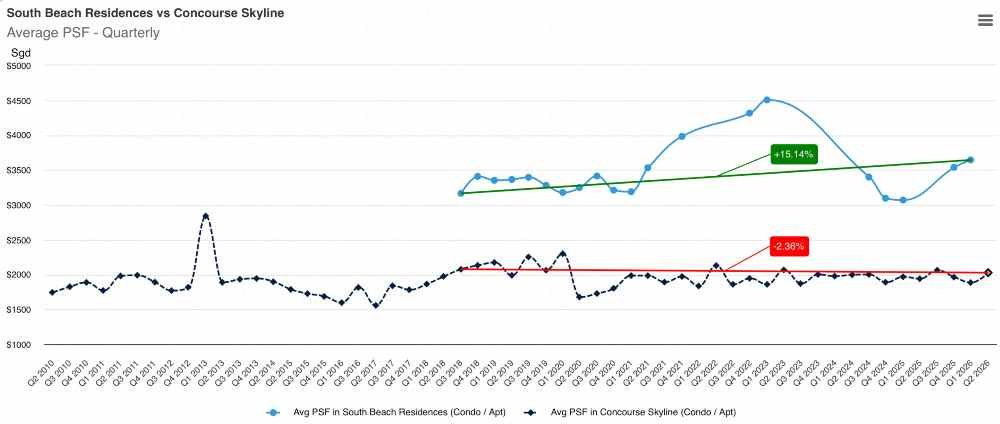
Average psf price performance - South Beach Residences vs Concourse Skyline
Investment Tip:
When comparing a new launch and a nearby resale:
- Construct a 10-year projection plan for each: entry price, expected rent, likely exit price, and all costs (stamp duties, renovation, maintenance).
- Evaluate which gives a better total return (capital gain + net rental), not just lower psf.
If a resale looks cheaper but offers weaker growth and dated facilities, the “cheap” entry may actually be a drag on long-term investment performance.
Location, Amenities, and Transformation (CCR, RCR, OCR)
Location remains one of the most decisive factors for private residential performance, but in Singapore, it is also important to scrutinise the URA Master Plan for future developments.
Location Considerations for Private Condos
- Connectivity and amenities:
Proximity to MRT stations, expressways, employment hubs, malls, and schools drives both resale demand and rental take-up. - Transformation potential:
Areas earmarked for new transport lines, business parks, or lifestyle clusters in the URA Master Plan often experience improved liveability and desirability over time.
Investment Tip:
When screening projects, undertake the following location checklist:
- Today’s fundamentals: distance to MRT, major roads, key employment nodes, primary/secondary schools, malls, and healthcare availability.
- Tomorrow’s potential: upcoming MRT lines, rezoning, new residential developments and commercial hubs, or waterfront/park enhancements indicated in the Master Plan.
If a project ticks both “strong today” and “improving tomorrow”, you can justify paying a reasonable premium, as both rental demand and resale appeal are likely to strengthen over time.
Cost, Financing, Cash Flow and Exit Strategy
The true cost of a private residential investment in Singapore goes far beyond the sticker price. Investors must factor in Buyer’s Stamp Duty, ABSD, legal fees, renovation, maintenance, property tax, and financing costs.
Financing and Holding Power
- LTV limits and TDSR cap how much leverage an individual can use, which restrains aggressive borrowing but also protects investors from financial overextension.
- Higher upfront duties, particularly for second and subsequent properties or foreign buyers, increase acquisition costs, raise the breakeven threshold, and lengthen the holding period needed to deliver satisfactory returns.
Investment Tip:
Before purchasing a private condo:
-
- Prepare a clear cash-flow projection that includes:
- Monthly mortgage at stress-tested rates
- Maintenance and sinking fund
- Property tax and insurance
- Estimated rental and realistic vacancy.
- Decide on a clear exit strategy:
- Who is your most likely buyer (upgrader, investor, owner-occupier)?
- Are they constrained by ABSD, income, or loan rules?
If a small fall in rent or a modest rise in interest rates would push the property into negative cash flow, and the exit buyer is unclear, the investment should be reconsidered or evaluate more conservatively.
Portfolio Strategy, Risk Management and Time Horizon
Private residential property should be treated as one part of your overall wealth plan. Do not put all your eggs into one basket.
Putting too much capital into one or two highly leveraged condos can amplify gains if the market rises. However, it may also increase losses, cash-flow pressure, and concentration risk if conditions turn weak.
A more balanced approach is to size each purchase conservatively and keep enough liquidity for diversification outside property.
Risk and Time Horizon
- Singapore’s private residential market has historically rewarded investors with medium-to-long-term holding power rather than short-term flipping.
- Adequate liquidity buffers and conservative leverage help investors ride out policy changes, interest rate spikes, or temporary rental softness without forced selling.
Investment Tip:
Treat your private condos as part of a broader investment portfolio:
- Limit your exposure to any single project or segment (e.g., OCR mass-market, CCR luxury) to avoid concentration risk.
- Assign each purchase with a clear objective: income stabiliser, growth driver, or legacy asset.
- Consider complementing direct private residential ownership with liquid instruments such as REITs to diversify sector and geographic risk while maintaining real estate exposure.
Singapore Property Investment Strategies
In Singapore, property investment is one of the most favoured options for wealth creation. Understanding common strategies will help investors align with their financial goals and risk tolerance. These include the following:
- Buying and Selling Properties: Buying undervalued properties or those with good capital appreciation potential and reselling them for profits in the future.
- Flipping Properties: Buying a new private property with promotional prices or "early bird" discount during the developer’s launch period and then flipping it for a profit after the Temporary Occupation Period (TOP) issuance or after the seller's stamp duty (SSD) period has lapsed. [Note: Selling before the SSD period will incur a substantial tax, impacting the investment adversely.]
- Investing in Private Properties: Although more expensive than HDB flats and executive condominiums, they have significantly fewer ownership restrictions. This allows property owners greater flexibility in managing their investments, such as seizing favourable market conditions to dispose of or acquire new assets.
- Renting out a Property: Buying and holding a property long-term to collect rental income from tenants and use the rents for mortgage financing.
- Investing in HDB Flats: Although HDB flats are primarily for owner-occupation and are subject to strict ownership restrictions, their affordability and housing grants given make them an attractive investment option for first-time buyers.
- Investing in Executive Condominiums (ECs): A bridge between public and private housing, subsidies and housing grants offered by the government make them an attractive, more affordable option than private condominiums. They have also been shown to offer good investment returns when fully privatised. However, carefully consider the ECs' recent extension of MOP (minimum occupation period) and how it fits into your investment horizon.
If you have any questions about Singapore property investment, including the utilisation of CPF funds for property financing, please email or WhatsApp me for an obligation-free consultation.
I can also help you identify high-potential property investments using our proprietary PrimeKey Analysis framework, which systematically evaluates eight critical factors to uncover opportunities with stronger upside and reduced risk.