The following is an in-depth review of the One-North Eden, a mixed-use development at the heart of Singapore’s R&D hub. In this review, I will seek to provide an unbiased examination of its design and locational attributes. In addition, I will evaluate its investment potential […]
Continue readingCategory Archives: New Launch Market Insights for CCR, RCR & OCR
- Key Attributes of One-North Eden
- One-North Eden Condo Site Location
- One-North Eden Project Information
- Unit Layout
- One-North Eden Site Plan
- Unit Mix
- Schematic Chart
- One-North Eden Facilities
- Smart Home System
- About one-north
- Close Proximity To The Greater Southern Waterfront
- Transformation of The West Region
- Excellent Transport Connectivity
- One-North Eden Enjoys Easy Accessibility to Amenities
- Holland Village - A Short Drive from One-North Eden
- Rail Corridor To Provide More Nature & Leisure Recreation
- Close Proximity to Medical Facilities
- Education Institutions Near One-North Eden
- Limited Housing Supply Within one-north
- One-North Eden Prices
- Review Conclusion - One North Eden's Investment Potential
- Developers of One-North Eden Condo
- More Property Reviews
It will also evaluates their current and emerging investment opportunities, as well as key factors shaping buyer and investor decisions.
Singapore’s residential property market offers compelling opportunities alongside notable challenges, particularly in navigating its intricate regulatory framework.
Through a series of calibrated property cooling measures, the government has successfully moderated speculative activity while sustaining long-term, stable price growth, thereby reducing the risk of asset bubbles.
This is one of the key reasons why property investment in Singapore has remained a resilient and attractive asset class for discerning local and foreign investors.
Even amid fluctuating interest rates and shifting buyer demographics, demand for new launches, such as private condos and Executive Condominiums (ECs), remains robust, underpinned by sound economic fundamentals and healthy household balance sheets.
With a steady, well-calibrated pipeline of exciting new launches spanning the island’s three main regions – Core Central Region (CCR), Rest of Central Region (RCR), and Outside Central Region (OCR) – prospective buyers and investors have been presented with an array of choices that cater to diverse lifestyle needs and investment objectives.
New launches have witnessed robust demand in 2025, driven by the Urban Redevelopment Authority’s (URA) tightly regulated land supply, far-sighted urban planning, steady economic growth, and long-term population trends and wealth inflows.
However, not all new launches performed equally well, as factors such as location, timing, and developers’ pricing and market strategies played a significant role.
Some of the areas covered by our new launch market insights will include the latest developments in Singapore’s residential landscape, URA Master Plans, and the different investment opportunities offered by Singapore’s Core Central Region (CCR), Rest of Central Region (RCR), and Outside Central Region (OCR).
It will also evaluate the pros and cons of purchasing a new launch (private housing and executive condominium) from an investment standpoint, as well as choosing between a new launch and resale private property.
Singapore Market Insights – Investing in CCR, RCR or OCR?
To understand the Singapore residential property market, its geography and how each region offers a different risk-reward profile is crucial in making an informed investment decision.
Core Central Region Market Insights: The Prestige Segment
The Core Central Region encompasses Singapore’s most prestigious addresses like Districts 9, 10, and 11, which include Orchard Road, Bukit Timah, and the Downtown Core. These areas have traditionally commanded premium prices and attracted the affluent and high-net-worth individuals seeking prestige and centrality.
However, they have also attracted buyers seeking a distinct and more cosmopolitan lifestyle, ranging from young professionals to asset-rich empty nesters.
Rest of Central Region Market Insights: The Mid-Tier Segment
The Rest of Central Region, also known as the city fringe, comprises areas such as Queenstown, Katong, Bishan, and Toa Payoh.
These neighbourhoods offer a balance between convenience and affordability – closer to the city centre than OCR developments, yet more affordable than CCR properties.
The RCR has witnessed significant growth in recent years, with properties in the region appreciating substantially as buyers seek value without sacrificing connectivity.
Outside Central Region Market Insights: The Mass Market Segment
The Outside Central Region comprises suburban estates like Tampines, Jurong, Woodlands, and Sengkang.
Once considered “ulu”, a colloquial term for being far-flung, these areas have been transformed by extensive MRT network expansion and government investment in regional centres. OCR properties typically offer larger living spaces at more accessible price points, appealing to the masses, such as young families and HDB upgraders.
It is also where all Executive Condominiums (EC) are built. Developed by private developers on government-subsidised land, ECs offer private condo-style living at a lower price point for the “sandwiched” class, but come with strict eligibility criteria.
New Launches Insight for CCR, RCR & OCR
Below, we present the latest market insights on new property launches across the CCR, RCR, and OCR, highlighting key developments and the factors shaping market trends.
Core Central Region (CCR) New Launches
Private properties in the CCR have experienced somewhat of a renaissance in 2025, with several new launches witnessing robust demand. These include Skye At Holland, Upperhouse At Orchard Boulevard, River Green, and The Robertson Opus.
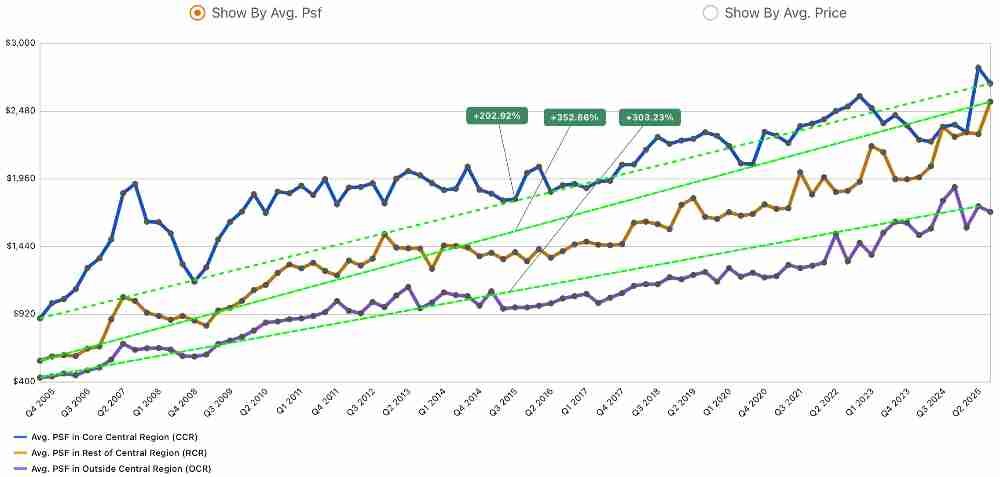
This can be attributed to the narrowing price gap of CCR properties versus those in the RCR and OCR. This is illustrated in the 20-year average price per square foot (psf) Chart 1 below where both the RCR and OCR converged against the CCR.
Demand for properties in the Core Central Region (CCR) has also been fuelled by rising inflows of foreign wealth, supported by a surge in family offices established in Singapore, as well as a growing number of new citizens and permanent residents, who either avoid paying ABSD or pay a significantly lower rate.
This has spurred renewed confidence among developers for prime location land, leading to strong results in recent government land tenders. These include sites at the Bukit Timah Road (Newton), Dunearn Road (Turf City), and Holland Link, which were sold at $1,820 psf ppr, $1,410 psf ppr, and $1,432 psf ppr, respectively.
At such land prices, CCR homes in these locations will likely be launched at up to $3.400 psf to $3,600 psf.
Activities in CCR properties have been relatively subdued in recent years following several hikes in the ABSD rate for foreigners acquiring private properties in Singapore. Currently, it stands at a hefty 60% (refer to the table below).
Timeline of ABSD for Foreigners
| Date Effective | ABSD Rate | Context / Cooling Measure |
| 8 Dec 2011 | 10% | Introduction of ABSD: First launched to curb the “red-hot” property market and speculative buying. |
| 12 Jan 2013 | 15% | Revision 1: Rates were raised across the board as prices continued to climb despite earlier measures. |
| 6 Jul 2018 | 20% | Revision 2: Sharp hike following a sudden surge in en-bloc activity and property prices. |
| 16 Dec 2021 | 30% | Revision 3: Post-pandemic cooling measure aimed at curbing the rapid recovery and price acceleration. |
| 27 Apr 2023 | 60% | Revision 4: A “pre-emptive” doubling of the rate to 60% to significantly dampen investment demand from abroad. |
Note: Citizens from the US, Iceland, Liechtenstein, Norway, and Switzerland are exempted from the ABSD levy when they purchase their first private residential property due to their free trade agreements with Singapore.
Rest of Central Region (RCR) New Launches
The Rest of Central Region (RCR) has seen strong interest from both homebuyers and property investors, with recent new launches such as Penrith, Zyon Grand, Promenade Peak, and Lyndenwoods attracting robust demand.
For those considering investing in an RCR property, Bloomsbury Residences offers a serious option due to its competitive pricing.
Properties in the RCR offer strategic advantages, balancing accessibility to the Central Business District and key employment nodes like One-North and Singapore Science Park, while maintaining price points approximately 20-30% below Core Central Region benchmarks.
Historical data have shown consistent capital appreciation (refer to Chart 1 above), supported by infrastructure improvements and urban renewal initiatives.
The region’s appeal stems from its relative affordability alongside strong connectivity and amenities. These factors have sustained interest from both owner-occupiers seeking upgrades and investors seeking medium to long-term growth opportunities.
Outside Central Region (OCR) New Launches
The OCR represents the heartlands, comprising a majority of HDB flats alongside mass-market private housing and executive condominiums. The demand is mainly driven by HDB upgraders, young families setting up own homes, and investors targeting more affordable entry points.
However, with the government’s sustained decentralisation efforts and ambitious MRT network expansion plans, the OCR has evolved from being considered ‘ulu”, a colloquial term for remote, to being more accessible.
This has resulted in journeys from the suburbs to the city now taking 45 minutes or less.
Improved connectivity to employment hubs such as Changi Business Park, an expanding MRT network, alongside enhanced access to amenities and lifestyle options, have elevated the OCR’s investment prospects.
OCR Private Property Launches
Recent new launches in the OCR that have witnessed strong demand include Parktown Residence, Springleaf Residence, and Faber Residence. This can be attributed to strong transportation connectivity and proximity to key job centres and commercial hubs.
New projects to look out for are Pinery Residences, and Narra Residences.
Executive Condominium Launches
Several executive condominium projects, such as Tenet, Aurelle @ Tampines, Otto Place, and Novo Place, have also seen strong take-up rates. This is because ECs offer compelling risk-adjusted returns due to their lower entry prices and eligible subsidies provided by the government.
Those looking into this particular housing segment can consider Coastal Cabana and Rivelle At Tampines.
Market Insights on Property Hotspots
Meanwhile, some of the property growth hotspots that have generated significant interest are Jurong Lake District, Tampines Regional Centre, Woodlands Regional Centre, One-North and Bayshore.
These regions are at the forefront of Singapore’s decentralisation strategy, creating alternative business hubs beyond the Central Business District. These growth hotspots have attracted significant investments, generated skilled employment, and driven regional economic activity.
Enhanced connectivity and the development of new commercial clusters have created vibrant live-work-play environments while supporting long-term economic growth.
Jurong Lake District: It is set to become Singapore’s largest business district outside the city, offering a vibrant live-work-play environment. Touted as a model for sustainable development with excellent MRT connectivity and waterfront lifestyle amenities, it will also benefit from the development of Jurong Innovation District and the Tuas mega port.
Tampines Regional Centre: As Singapore’s first regional centre, it provides comprehensive retail, employment, and lifestyle amenities along with strong transport links. With the construction of the mega Changi Airport Terminal 5 and wider East Region development, it is poised for enhanced economic growth, increased job opportunities, and sustained property demand, solidifying its status as a vibrant property hotspot.
Woodlands Regional Centre: It is transforming into a northern gateway with integrated transport hubs, cross-border RTS link, major malls, and new business and lifestyle clusters. The development of the Johor-Singapore Special Economic Zone will further enhance cross-border business synergies, attract multinational investments, and stimulate demand for homes, offices, and retail spaces.
One-North: An evolving biomedical, infocomm technology, and media hub near Singapore’s Greater Southern Waterfront, the mixed-use residential precinct near NUS, research institutions, and top schools offers great investment potential. With its excellent MRT connectivity and the URA planning to introduce up to 6,000 new public and private homes in Dover-Medway, alongside commercial spaces, it offers an appealing live-work-play-study environment.
Bayshore: Located near East Coast Park, it offers rare waterfront living. Major upcoming developments including the Bayshore MRT station (Thomson-East Coast Line) and Long Island development promise to improve accessibility and amenities. In turn, they will help to drive demand for properties and boost property values in the long-term.
The Pros and Cons of Purchasing New Launch Properties
Purchasing new property launches – private condos and Executive Condominiums (ECs) – offer distinct advantages, such as capitalising on ‘first-mover’ pricing and lower initial financial outlay through progressive or deferred payment schemes.
However, buyers remain exposed to delivery risks and market volatility prior to project completion.
Here’s a list of the pros and cons of purchasing a new launch.
Advantages of Buying a New Launch
Unit Selection and First-Mover Advantage
- Early buyers have access to the widest range of floor levels, orientations, and unit types.
- The chance to secure preferred views, privacy, and lifestyle alignment.
- First-mover advantage enhances future resale potential.
Favourable Payment Structure
- Progressive payment scheme: 20% upfront (5% option + 15% signing of Sales Agreement), 80% paid progressively.
- Capital remains available for alternative uses or investment during the construction period.
- Flexibility to complete existing property sales with less time pressure. The existing property is required to be sold only within 6 months from the date of the Temporary Occupation Permit (TOP) or the Certificate of Statutory Completion (CSC) for the new property, whichever is earlier.
New Condition and Cost Efficiencies
- Brand-new fixtures and appliances with warranty coverage.
- No immediate renovation costs required.
- Buyers protected by 12-month Defects Liability Period (DLP).
- Developer incentives may include furniture packages, stamp duty absorption, or legal fee subsidies.
Capital Appreciation Potential
- Properties often appreciate during the construction phase.
- Historical data demonstrates new launches consistently outperform comparable resale properties, despite their higher prices.
- Step-up pricing strategy by developers establishes price support, benefitting early-entrants.
Disadvantages of Buying a New Launch
Extended Waiting Period
- Completion timelines range from 3-5 years post-purchase.
- Personal circumstances may change (employment, family size, finances) before occupancy.
- Reduced flexibility for evolving needs.
Unforeseen Variables
- Show flats provide limited insight into actual unit conditions, views, and noise levels.
- Surrounding developments may obstruct views post-completion.
- Actual build quality may not align with expectations.
Price Premium and Market Risk
- New launches command premiums over comparable resale properties.
- Interest rate surges may adversely affect affordability.
- High developer profit margins baked into pricing can potentially limit post-TOP capital appreciation.
- Market corrections or oversupply situations may result in negative equity post-completion.
Construction and Regulatory Risks
- Potential delays in obtaining Temporary Occupation Permit (TOP).
- Matching timelines for selling or renting your current place may cause issues.
- Developer issues like bankruptcy, though rare in Singapore’s regulated environment, create uncertainty.
Strategic New Launch Market Insights: Which Region to Choose?
It depends.
If you are an investor seeking yield, the OCR and certain pockets of the RCR are your best bets. The proximity to industrial parks and regional centres ensures a steady stream of tenants.
If you are looking for capital preservation and legacy planning, the CCR remains unmatched. Land is finite in Orchard and Bukit Timah; these are trophy assets that stand the test of time.
For HDB upgraders, Executive Condominiums (ECs) provide an affordable entry into private condo-style living. With government subsidies and priced 20-30% below comparable mass-market private condominiums at launch, this essentially allows buyers to “lock in” profits almost immediately.
However, there is a trade-off – observing a 5-year MOP (Minimum Occupation Period) before reselling to Singaporeans and a 10-year MOP to foreigners.
Nevertheless, during this holding period, ECs usually appreciate, with significant upside seen when they approach full privatisation at the 10-year mark when foreign demand enters the market.
In essence, you pay less upfront, hold for the required period, and benefit from capital appreciation as ECs transition to private status.
Conclusion: Making an Informed Move
The Singapore property market is sophisticated, regulated, and can be rewarding for those who undertake rigorous due diligence.
Whether you are eyeing a prestigious address in the Core Central Region, a family-oriented Executive Condominium, or a value-driven mass-market private property in the Outside Central Region, the fundamentals remain constant: location, timing, pricing, and sound financial planning.
Successful property investment demands more than aspiration – it requires data-backed strategy and professional insight.
At Sg Home Investment, we will equip you with comprehensive information, expert guidance, and analytical tools to help you navigate Singapore’s complex residential landscape with confidence.
From in-depth project analysis to detailed financial calculations, we ensure that your property decision is data-driven and informed by strategic foresight.
Please WhatsApp me for the latest new launches or if you require any assistance. Alternatively, check out our property resources and guides to help you navigate Singapore’s residential property market.
The Reef At King’s Dock – Waterfront Condo Review
The following is an in-depth review of The Reef At King’s Dock Condo and what differentiate it as a viable investment alternative vis-a-vis other newly launched developments. In this review, we seek to provide an unbiased examination of its design, locational attributes and investment potential. Please […]
Continue readingMidtown Modern By GuocoLand – Condo Review
This is a review of Midtown Modern, an exclusive integrated development to be built atop the Bugis MRT interchange station and along Tan Quee Lan Street which features a row of conserved shophouses. Situated just across Bugis Junction, it enjoys a plethora of retail, dining, […]
Continue readingKi Residences Condo @ Sunset Way
The project will yield 660 units consisting of ten 12-storey high blocks that will blend seamlessly with the lush greenery and idyllic surroundings. Taking inspiration from the Japanese word “ki”, the design concept seeks to harmonise its inhabitants with their natural surroundings to improve […]
Continue readingKopar At Newton – An Investment Overview
The Kopar At Newton condominium is an exclusive development in Singapore’s prime District 9 near the Newton Circus. It is just opposite the famous Newton Food Centre and about 5 minutes walk to the Newton MRT station. Surrounding it are mostly high-end residential properties, hotels […]
Continue reading