

- Customised PrimeKey Analysis For Different Buyer Profiles
- Using PrimeKey Analysis - The Evaluation Workflow
- The Case for Using PrimeKey’s Data-Driven Property Analysis
- The PrimeKey Edge - Making Efficient & Smarter Property Investment Decisions
- PrimeKey Analysis - The 8 Factors Explained
- How the Scores are Calculated
- PrimeKey Analysis Investment Score - A Visual Illustration
- Disclaimer
- New Property Launches
PrimeKey Analysis is a data-driven property investment framework designed to assess the investment potential of private residential properties (new launches and resale homes) with greater clarity, precision, and objectivity.
It gives investors, homebuyers, and property owners clear, evidence-based insights into the investment strengths and weaknesses of private residential developments, helping them make confident buying and selling decisions.
By translating complex market dynamics into transparent, investment-grade scores, PrimeKey Analysis removes speculation and intuition from decision-making.
Each residential project is evaluated on eight core factors shown to influence capital appreciation, rental yield, and future resale performance. These indicators are rigorously derived from actual market behaviour and validated against buyer demand patterns unique to Singapore’s private residential property landscape.
To confirm the effectiveness of our PrimeKey Analysis framework, we back-tested it with 593,000 past residential transactions. The results provide empirical support for the framework's underlying premise: developments with stronger investment fundamentals, as reflected in higher PrimeKey scores, have generally demonstrated greater resilience and stronger long-term performance. Check out our PrimeKey Case Studies.
The eight factors used for evaluation are:
- Distance to MRT Station.
- Growth Hotspots.
- Government Land Sale (Future Supply).
- Project Size.
- Remaining Tenure.
- Nearby Primary Schools.
- MOP Cluster (HDB Upgrader Demand).
- Rental Demand (Yield).
Customised PrimeKey Analysis For Different Buyer Profiles
As investment priorities vary across buyer segments, each profile assigns different weightings to the eight key factors based on their housing needs, lifestyle considerations, and financial objectives. Common buyer profiles include:
- Couples with no kids.
- Young families.
- Mature Families.
- Multi-generational families.
- Retirees.
- HDB upgraders.
- Transgenerational real estate buyers (legacy planning).
- Luxury-focused buyers.
- Privacy-focused buyers.
- Others.
To address different buyer priorities, PrimeKey Analysis' eight core investment factors can be adjusted to profile-specific weightings. This generates a customised score that more accurately reflects the strategic objectives of each investor, rather than relying on a generic, one-size-fits-all evaluation.
PrimeKey Analysis Buyer Profile Customisation
The example below illustrates how PrimeKey Analysis can be customised for different buyer profiles. Each of the eight factors can be reweighted to reflect the different priorities.
Based on these customised weightings, PrimeKey Analysis generates either a Buying Score or an Investment Score. This score will help determine whether the property aligns with the buyer’s intended objectives, whether for owner-occupation, lifestyle, wealth preservation, investment, or other needs.
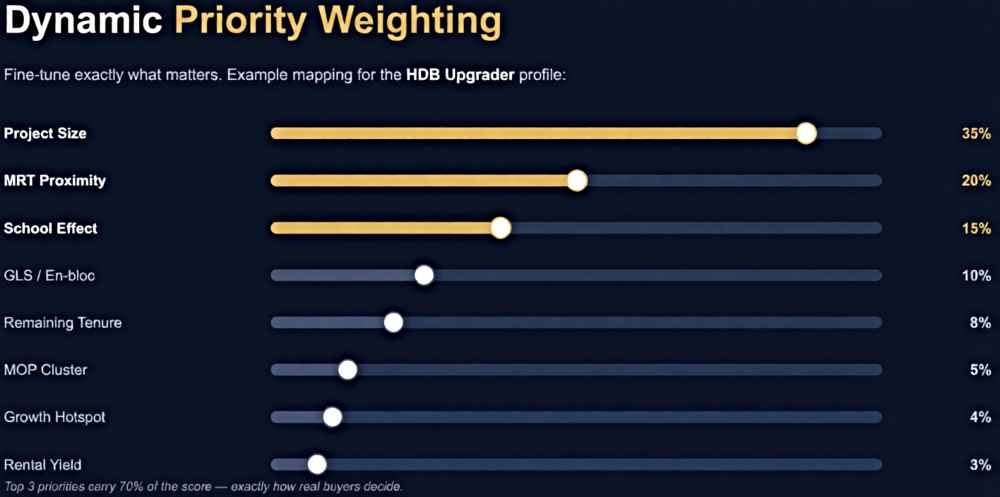
Example: PrimeKey Analysis for HDB Upgraders
The Science Behind PrimeKey Analysis
PrimeKey Analysis is based on Rank Order Centroid (ROC), a mathematical technique that converts a simple ranked list of criteria into precise, weighted percentages. It was formalised in 1996 by mathematicians F. Hutton Barron and Bruce E. Barrett in Management Science. It shows that people can rank what matters more easily than assign exact percentages.
In PrimeKey Analysis, ROC is used to customise property evaluations based on buyer profiles dynamically. Instead of scoring properties using static, equal weights across all categories, ROC allows buyers to rank their priorities (e.g., MRT proximity over rental yield). The algorithm converts those rankings into weighted percentages, with top priorities carrying the greatest weight. This ensures property scores accurately reflect a specific buyer's unique needs rather than a generic average.
Using PrimeKey Analysis - The Evaluation Workflow
| Step | Stage | The Process |
| 01 | Align your objective | We first identify your property goal – whether it’s for own-stay, investment, upgrading, or asset progression. This will shape your decision with the help of our scoring framework based on the 8 factors. |
| 02 | Score real options | A PrimeKey Analysis is run through your shortlisted projects and comparable alternatives to highlight blind spots, strengths, and hidden risks you might not see or anticipate. A value for each project will be generated for comparison side-by-side through its objective data-driven framework. |
| 03 | Entry & exit plan | PrimeKey Analysis will help you determine how safe is it to enter while mapping out a realistic buyer pool for your eventual exit. Understanding your future buyers before you buy is an important factor that is often overlooked. |
The Case for Using PrimeKey’s Data-Driven Property Analysis
Singapore, which has been consistently ranked among the world’s most expensive residential property markets, the difference between a sound purchase and a painful misstep increasingly hinges on the quality of information a buyer can access.
For far too long, buying decisions have been shaped by gut instinct, persuasive agent narratives, social media hype, and a constant hum of market noise. Some may also succumb to personal impulse after a visit to the show flat.
As property prices continue to rise and the market grows more complex, the margin for error is shrinking, and badly informed choices can cause financial distress for years to come.
To mitigate any investment missteps, PrimeKey Analysis empowers users to assess residential projects systematically to reveal hidden risks and growth drivers through a data-driven approach.
The PrimeKey Edge - Making Efficient & Smarter Property Investment Decisions
Relying on data over intuition provides a precise, objective, and empirically validated method for assessing a property’s investment potential. Here’s why it outperforms gut feel and guesswork:
- Objectivity Over Emotion: By scoring properties against a standardised set of criteria, PrimeKey Analysis systematically eliminates personal bias. It remains impervious to superficial appeal, such as the allure of a stunning show flat or a polished sales pitch.
- Efficient Investing: Saves hours of manual research, delivering a benchmark score for quick comparisons across residential projects.
- Comparability Across Property Types: Whether evaluating a new launch, a resale condominium, or an executive condominium, PrimeKey Analysis provides a consistent scoring basis – enabling genuine like-to-like comparison.
- Forward-Looking Intelligence: Most buyers look back at past transaction prices for cues. However, PrimeKey Analysis looks forward by assessing government planning intent, GLS pipelines, MOP cycles, and tenures to assess where a property is likely to be in the future.
- Risk Identification Before Commitment: Hidden risks – weak tenure, poor transport connectivity, thin upgrader demand, low rental yields – are exposed before commitment, not discovered painfully after the fact.
- Confidence in Decision-Making: Buyers who understand the data underpinning their purchase are far less vulnerable to post-purchase anxiety, market noise, or peer pressure. Their decision is anchored in evidence, not emotion.
- Clear Exit Strategy: PrimeKey Analysis evaluates every property with a defined exit strategy from the outset, engineered to maximise investment returns. This structured approach fundamentally elevates the quality of purchase decisions.
PrimeKey Analysis - The 8 Factors Explained
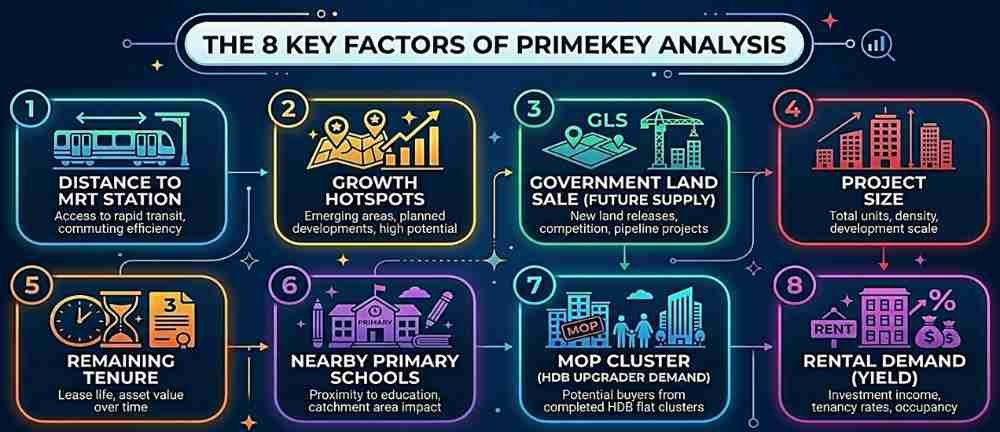
The power of PrimeKey Analysis lies in the rigour and relevance of the eight factors it measures. Below is a detailed explanation of each and why it matters.
1. Distance to MRT Station
 Walkability to public transport has consistently shown to be an influential driver of both rental demand and resale performance in Singapore. Properties within a 5- to 10-minute walk of an MRT station attract a significantly larger pool of tenants and buyers than those requiring a bus connection or extended walk – a particularly important consideration in Singapore’s hot and humid climate.
The benefits of strong MRT proximity include:
- Stronger rental demand, leading to lower vacancy risk.
- Greater negotiating power for landlords and sellers.
- A broader buyer pool during resale.
- Better price resilience when new competing projects enter the vicinity.
A property that scores well on MRT proximity is not just convenient to live in – it is also more liquid and more price-resilient during market downturns.
| Score | Stars | Criteria |
| 5 / 5 | ★★★★★ | < 5 min walk |
| 4 / 5 | ★★★★ | 5 – 10 min walk |
| 3 / 5 | ★★★ | 10 – 12 min walk |
| 2 / 5 | ★★ | 12 – 14 min walk |
| 1 / 5 | ★ | > 14 min walk |
2. URA Masterplan Growth Hotspots
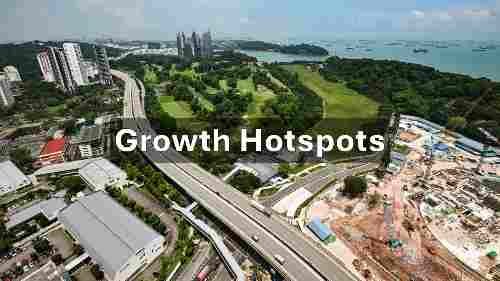 Singapore’s URA Masterplan outlines the government’s long-term vision for land use, infrastructure, and economic development.
Locations within major growth corridors – such as Marina Bay, Bidadari, Jurong Lake District, Tampines Regional Centre, Woodlands Regional Centre, and Lentor, to name a few – have historically delivered stronger price appreciation than other mature estates.
PrimeKey identifies whether a property sits within an active growth zone, giving buyers a forward-looking advantage that past transaction data alone may not provide.
The benefits of a strong URA Masterplan positioning include:
- Early exposure to capital appreciation ahead of infrastructure completion.
- Government-led development creates lasting demand, independent of short-term market fluctuations.
- A broader pool of future buyers drawn by improved amenities and connectivity.
- Greater price resilience as transformation plans materialise, fuelling sustained interest.
| Score | Stars | Criteria |
| 5 / 5 | ★★★★★ | Within the Growth Hotspot boundary |
| 4 / 5 | ★★★★ | Within 1 – 500m of GHS |
| 3 / 5 | ★★★ | 501 – 1,000m of GHS |
| 2 / 5 | ★★ | 1,001 – 1,500m of GHS |
| 1 / 5 | ★ | > 1,500m from GHS |
3. Government Land Sales (GLS) Pipeline
 Upcoming Government Land Sales (GLS) in the vicinity of a property are an important forward-looking indicator of price direction. When a new site is awarded at a higher land cost, it sets a fresh price benchmark for the neighbourhood.
This has a dual effect: owners of existing developments tend to hike their asking prices while buyers view older projects nearby as relatively more affordable alternatives, which will support both demand and price growth.
This pattern has been consistently observed across Singapore in Tampines, Pasir Ris and Punggol, and more recently in Woodlands, Lentor and Tengah. Understanding the GLS pipeline helps buyers:
- Gauge future price benchmarks in the neighbourhood.
- Assess whether current options represent relative value.
- Anticipate future supply competition at the point of exit.
- Identify locations where demand momentum is likely to build organically.
| Score | Stars | Criteria |
| 5 / 5 | ★★★★★ | 4 or more nearby plots |
| 4 / 5 | ★★★★ | 3 nearby plots |
| 3 / 5 | ★★★ | 2 nearby plots |
| 2 / 5 | ★★ | 1 nearby plot |
| 1 / 5 | ★ | No nearby plots |
4. Development Size (Number of Units)
 The scale of a development has a direct bearing on liveability, operating costs, and market liquidity.
Larger developments tend to offer a wider range of facilities – multiple swimming pools, gyms, function rooms, landscaped grounds – while benefiting from economies of scale that keep monthly maintenance contributions manageable.
From an investment perspective, larger developments also generate more consistent resale transaction volume. This means:
- Greater visibility and recognition within the estate.
- More regular market transactions to anchor valuations.
- Better valuation assessments from banks.
- A deeper, more diversified pool of potential buyers and tenants.
- Liquidity risk – the risk of being unable to exit at an acceptable price within a reasonable timeframe – is considerably lower in large-scale developments compared to boutique projects with only a handful of units.
| Score | Stars | Criteria |
| 5 / 5 | ★★★★★ | ≥ 400 units |
| 4 / 5 | ★★★★ | 300 – 399 units |
| 3 / 5 | ★★★ | 200 – 299 units |
| 2 / 5 | ★★ | 100 – 199 units |
| 1 / 5 | ★ | < 100 units |
5. Remaining Lease Tenure
 For 99-year leasehold properties, which comprise the majority in Singapore’s private residential market, the remaining lease term is one of the most consequential factors affecting long-term value, financing eligibility, and resale appeal.
As tenure falls below certain thresholds, CPF usage restrictions and loan limits narrow the pool of buyers. Bala’s Curve, referenced by the Singapore Land Authority, shows that price depreciation accelerates as the lease approaches its later stages.
The risks of overlooking remaining lease tenure include:
- Shrinking buyer eligibility as CPF and loan restrictions tighten with age.
- Accelerating price depreciation during the holding period.
- Reduced negotiating power at the point of resale.
- Significant capital committed to an asset with diminishing long-term appeal.
| Score | Stars | Criteria |
| 5 / 5 | ★★★★★ | > 90 years remaining |
| 4 / 5 | ★★★★ | 85 – 89 years |
| 3 / 5 | ★★★ | 80 – 84 years |
| 2 / 5 | ★★ | 75 – 79 years |
| 1 / 5 | ★ | < 75 years |
6. Rental Yield (For Resale Units)
 Rental yield is more than a cash-flow metric – it is a reliable indicator of genuine, ground-level demand. A healthy yield demonstrates that the development commands consistent tenant interest, which in turn reflects broader appeal to future owner-occupiers and investors.
As a guide, rental yield benchmarks for Singapore’s three main market segments should not deviate too much from the following:
- Around 3% for Core Central Region (CCR) properties.
- Around 3.5% for Rest of Central Region (RCR) properties.
- Around 4% for Outside Central Region (OCR) properties.
Developments that fall materially below these thresholds merit closer examination. Depressed yields are frequently symptomatic of deeper structural issues – ageing facilities, intensifying competition from newer developments, or a misalignment between unit mix and local tenant demand – each of which poses a tangible risk to long-term capital performance.
| Score | Stars | Criteria |
||
| 5 / 5 | ★★★★★ | CCR ≥ 3% | RCR ≥ 3.5% | OCR ≥ 4% |
| 4 / 5 | ★★★★ | CCR 2.5–2.9% | RCR 3.0–3.4% | OCR 3.5–3.9% |
| 3 / 5 | ★★★ | CCR 2.0–2.4% | RCR 2.5–2.9% | OCR 3.0–3.4% |
| 2 / 5 | ★★ | CCR 1.5–1.9% | RCR 2.0–2.4% | OCR 2.5–2.9% |
| 1 / 5 | ★ | CCR < 1.5% | RCR < 2% | OCR < 2.5% |
7. Proximity to Primary Schools
 In Singapore’s competitive primary school registration landscape, proximity matters profoundly for families with children.
Homes within 1 km of established primary schools not only benefit from Phase 2C enrolment priority, but they also attract a consistent pool of family buyers and tenants who value this access for years to come.
The investment implications are significant:
- Consistent owner-occupier demand, which provides stability in softer markets.
- Greater price resilience during broad market corrections.
- A clear and compelling sales narrative that resonates with a large buyer demographic.
- Potential price premiums sustained by limited supply within the 1km catchment zone.
| Score | Stars | Criteria |
| 5 / 5 | ★★★★★ | 4 or more schools within 1km |
| 4 / 5 | ★★★★ | 3 schools within 1km |
| 3 / 5 | ★★★ | 2 schools within 1km |
| 2 / 5 | ★★ | 1 school within 1km |
| 1 / 5 | ★ | 0 schools within 1km |
8. HDB MOP Upgrader Demand
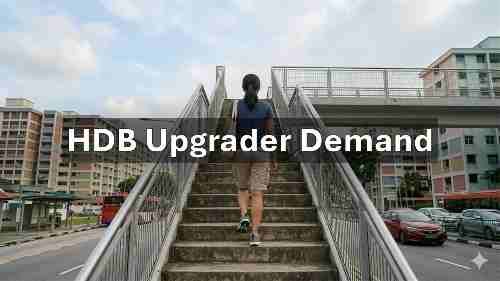 HDB upgraders are among the most consistent buyer groups in Singapore’s private residential property market.
Regardless of economic conditions, households that have completed their Minimum Occupation Period (MOP) – typically five years for HDB flats until the new HDB flat classifications kick in – naturally aspire to upgrade to private property in familiar, established neighbourhoods.
Estates with large clusters of HDB flats approaching MOP simultaneously tend to experience a natural surge in demand for private property. These households are typically at a more advanced stage of their careers, with growing families and the financial capacity to upgrade.
This creates:
- A deeper, more reliable future buyer pool for resale.
- Stronger owner-occupier demand rather than speculative buying.
- Better price stability during market fluctuations.
- Faster resale absorption for appropriately sized and priced units.
| Score | Stars | Criteria |
| 5 / 5 | ★★★★★ | > 2,000 MOP units nearby |
| 4 / 5 | ★★★★ | 1,500 – 1,999 units |
| 3 / 5 | ★★★ | 1,000 – 1,499 units |
| 2 / 5 | ★★ | 500 – 999 units |
| 1 / 5 | ★ |
How the Scores are Calculated
The final score in our PrimeKey Analysis is a percentage based on the total number of stars earned across all categories.
The Math:
- Total Stars Available: There are 8 categories, and each has a maximum of 5 stars.
Maximum Score = 8 categories X 5 stars = 40 stars
- Weighted Percentage: Your property’s score (%) is the total stars earned divided by the maximum possible stars.
Final Score (%) = [Total Stars Earned / 40] X 100
The Colour Grading (The Verdict)
Once the percentage is calculated, the property is placed into a colour-coded scoring framework to help investors make a quick and informed decision:
| Color | Percentage Range | Interpretation |
|
GREEN
|
Above 75% | Investment Grade – Exceptional fundamentals with high capital growth potential. |
|
TEAL
|
50.1% – 75% | Moderate Risk – Sound investment with manageable risks or minor trade-offs. |
|
ORANGE
|
25.1% – 50% | Elevated Risk – Several weak areas may limit growth potential; suitable only for specific personal objectives. |
|
RED
|
Below 25% | Proceed with Caution – Significant deficiencies; high probability of capital loss or underperformance. |
PrimeKey Analysis Investment Score - A Visual Illustration
A radar chart will be provided to help you visualise the investment profile of the property you are considering a a glance.
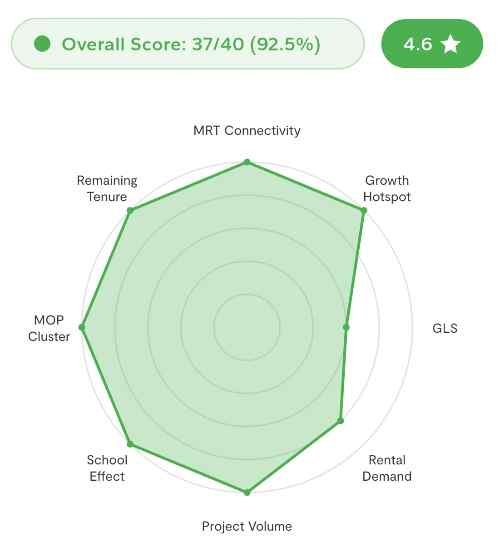
If you are considering investing in a new launch or resale condo, we will be happy to offer you our complimentary PrimeKey Analysis Report. To learn more, you can view our sample reports for Kent Ridge Hill Residences and Verandah Residences.
[ CLICK HERE FOR YOUR COMPLIMENTARY PRIMEKEY ANALYSIS REPORT ]
Disclaimer
The PrimeKey Analysis framework is an investment scoring tool for objective property evaluation and does not constitute financial advice or guarantee investment returns.
What it does not do:
PrimeKey Analysis offers a data-backed assessment of a property's macro-level growth potential and is designed as an objective evaluation framework. Therefore, it does not take into account the following:
- Property Valuation: It is not a valuation framework and does not assess whether a property is under- or overvalued, as it does not consider purchase prices.
- Past Market Trends: It does not consider past profit or loss transaction data to reach its conclusion.
- Unique Unit Attributes: It does not factor in specific unit layouts, physical unit or development conditions (e.g., views, ventilation, quality of facilities), or the reasonableness of individual sellers.
- Ongoing Ownership Costs: It does not factor in recurring maintenance costs, including management fees, sinking fund contributions, or other property-related expenses that may affect the overall cost of ownership.
Why:
- Dynamic Market Drivers: Past performance does not necessarily indicate future growth. Market conditions, government policies, infrastructure developments, supply, demand and future entry prices can materially influence property performance.
- Property-Specific Factors: Unit layouts, views, ventilation, floor levels, facility quality, development design and unit-type distribution are specific to individual properties or units and fall outside PrimeKey Analysis's macro-level scope.
- Purchase Price and Ownership Costs: Purchase price, maintenance fees, sinking fund contributions and other ownership expenses vary by unit and buyer. These are excluded so PrimeKey Analysis remains focused on the property's underlying growth potential rather than individual investment returns or total ownership costs.
Objective Scope
These exclusions are intentional, allowing PrimeKey Analysis to apply a consistent, data-driven framework across both new launches and resale residential properties. It helps identify properties that warrant closer consideration, including those that may not have been on your initial shortlist, while providing an objective side-by-side comparison of shortlisted properties.
PrimeKey Analysis is designed to support the decision-making process, and not replace it. The final investment decision should still consider individual circumstances, objectives and other property-specific factors that require human judgment.
Meanwhile, check out our new launches review for detailed insights into the latest and upcoming projects.
If you are looking for more information about Singapore’s property market, please refer to our property guides below:
- Property Regulations.
- Property Finance & Costs.
- Property Marketing
- Property Hotspots.
- Property Investment Guides.
- Private Property Guides.
- Executive Condo Guides.
- HDB Guides
New Property Launches
The following are the reviews of new property launches you may be interested in. WhatsApp me to receive you free copy of our PrimeKey Analysis Report.
- Lucerne Grand next to Lakeside MRT.
- Lentor Gardens Residences situated near Lentor MRT.
- Vela Bay situated next to Bayshore MRT.
- Dunearn House situated near Sixth Avenue MRT.
- Amberwood at Holland situated at the new Holland Plain precinct.
- Thomson Reserve situated next to Upper Thomson MRT.